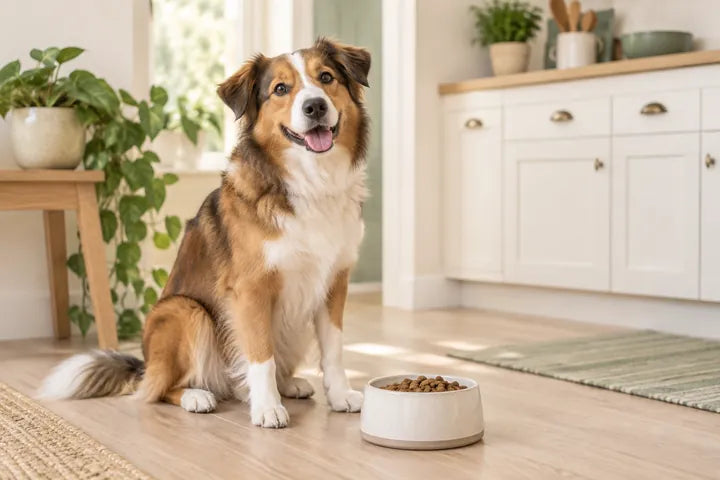
Slow feeder dog digestion claims are partly accurate and partly inflated. A maze bowl does not improve absorption, and it does change how much air a dog swallows with a meal, which is where most of the benefit sits.
This is general education rather than a product review. It explains what fast eating actually causes, which dogs benefit, and how to test a feeder so the result means something.

Slow feeder dog digestion: what fast eating actually causes
When a dog eats quickly, they swallow air along with food. That air has to move somewhere, and it usually leaves as gas or as a belch, and in some dogs it contributes to vomiting shortly after a meal.
A large meal eaten fast also distends the stomach, which can trigger reflux or discomfort in sensitive dogs, and in deep-chested breeds it is one of the factors discussed in relation to bloat.
What slow feeding does not do is change how food is digested or absorbed. Enzymes, gut health, and the composition of the diet decide that, and no bowl alters them. The honest claim is narrower: slower eating reduces air intake, moderates meal size per unit of time, and reduces the chance of a dog bolting a whole portion in under a minute. That is worth having when the problem is speed, and it is irrelevant when the problem is something else. If gas and stool changes are part of the picture, diet and the gut community matter as well (gut microbiome and diet), and stool quality often responds to the type and amount of fibre rather than to how quickly the meal is eaten (dietary fiber review).
What do owners get wrong first?
Measure the current meal time first.
If a dog already takes five minutes to finish, a maze bowl adds frustration without changing anything, and the real problem lies elsewhere.
The second mistake is changing the feeder and the food in the same week, which makes the result uninterpretable. The third is choosing a design that frustrates the dog, because stress at mealtimes affects appetite and behaviour, and a tool that creates anxiety is worse than no tool. The fourth is expecting a bowl to fix vomiting, when vomiting has many causes and the Merck Veterinary Manual treats it as a sign rather than a diagnosis. Before buying anything, time three meals, note how much air your dog appears to swallow, and check whether the portion size matches your dog’s needs, since oversized meals are a common contributor.
Which dogs benefit and which do not?
The tool suits some dogs and not others.
The table below pairs common situations with the expected benefit, and frustration is the main reason to stop.
| Situation | Likely benefit | Better alternative |
|---|---|---|
| Dog finishes meals in under a minute | High | Any slow feeder or scatter feed |
| Gas or vomiting shortly after meals | Moderate to high | Smaller, more frequent meals too |
| Multiple dogs competing for food | Moderate | Feed in separate rooms first |
| Dog becomes frustrated or guards the bowl | None | Snuffle mat or scatter feeding |
| Flat-faced breed or dental pain | Low | Shallow bowl, smaller meals |
Portion size matters as much as the bowl, and the site’s guidance on how much to feed explains how to measure it. Treats count towards daily intake, and the site’s advice on treat limits explains how to keep the total in view. Nutrient requirements are set in relation to energy rather than volume, so a bowl that slows eating does not change the amount a dog needs (Merck Veterinary Manual).
What to change, in what order
Change one thing and measure.
First, time the meal and split the portion into two smaller meals if the daily amount allows, since meal size is the simplest variable to adjust. Second, introduce one feeder design and watch the first three meals for signs of frustration.
Third, if speed is no longer the issue and the signs persist, keep the feeder but look at the diet and the treat list, changing one item at a time. Fourth, if nothing changes after a fortnight, stop adjusting the bowl and arrange an assessment. Keep meal times regular, because irregular feeding also affects appetite and stool. If you are switching food at the same time, transition it gradually, and diet labelling conventions are explained in AAFCO consumer material for anyone comparing products.
What should you see, and when?
Gas changes show up quickly.
Expect a reduction within days rather than weeks, and expect meal duration to increase from seconds to several minutes, which is the change you are actually testing.
Record meal duration, gas frequency, and any vomiting or discomfort after meals, then compare the week before and the week after. If vomiting continues, note the timing relative to meals, because vomiting hours later points to a different mechanism. If your dog loses interest in eating, that is a reason to stop and try a different approach rather than persisting with a design they dislike. Where the problem turns out to be dietary, the right experiment is a diet change with a defined period and a clear measure.
When does fast eating need a vet visit?
Book an appointment if vomiting continues.
Seek emergency care for a distended, painful abdomen, unproductive retching, or a dog that cannot settle, because those signs are not explained by eating speed.
Bring your log, including meal duration and any vomiting, and ask whether the pattern suggests a digestive condition, a food reaction, or a structural problem. Ask what to change first, and ask whether the portion size is appropriate for your dog’s weight and activity, since overfeeding is often the hidden variable. If a diet change is recommended, transition gradually, and the site’s guide to switching food explains how. The site’s pet supplement safety guide covers the framework if products are added later.
What to record and review
Two weeks of notes answers the question.
Record how long each meal takes, how much air the dog seems to swallow, gas frequency, stool quality, and anything else that changed, then review the page rather than relying on impressions.
If the feeder helped, keep it and note the meal duration you achieved, because that number tells you whether the change is holding. If it did not help, stop using it and look at the other variables rather than buying a second design. Keep the older pages when the routine changes, and the site’s FAQ answers common questions about feeding routines.

If you want the wider framework for feeding decisions, read the site’s pet supplement safety guide.
FAQ
Do slow feeders help with digestion in dogs?
They help mainly by slowing eating and reducing swallowed air, which can reduce gas, vomiting after meals, and the risk of gulping large amounts at once. They do not change how nutrients are absorbed and they will not fix a digestive condition. For a dog that eats very quickly, a slow feeder is a cheap, reversible test that often produces a clear answer within days.
Are puzzle bowls safe for all dogs?
No. Dogs that become frustrated, guard the bowl, or try to chew the plastic may do better with a scatter feed or a snuffle mat instead. Brachycephalic breeds and dogs with dental pain can struggle with deep maze designs. Watch your dog for the first few meals and stop if they become distressed, because a feeding tool that creates stress is working against the plan.
Can a slow feeder help a dog that vomits after eating?
Sometimes, if the vomiting is caused by rapid eating and gulping air. It will not help if the cause is a stomach or intestinal condition, a food reaction, or an obstruction. If vomiting continues with a slow feeder, or if your dog also loses weight or goes off food, the next step is a veterinary assessment rather than a different bowl.
How long until I see a difference with a slow feeder?
Gas and post-meal vomiting often improve within a few days if rapid eating was the cause, while weight and appetite changes take longer to assess. Keep everything else in the routine identical during the test, including treats and meal times, so the change is attributable to the feeder. If nothing changes within a fortnight, the cause lies elsewhere.