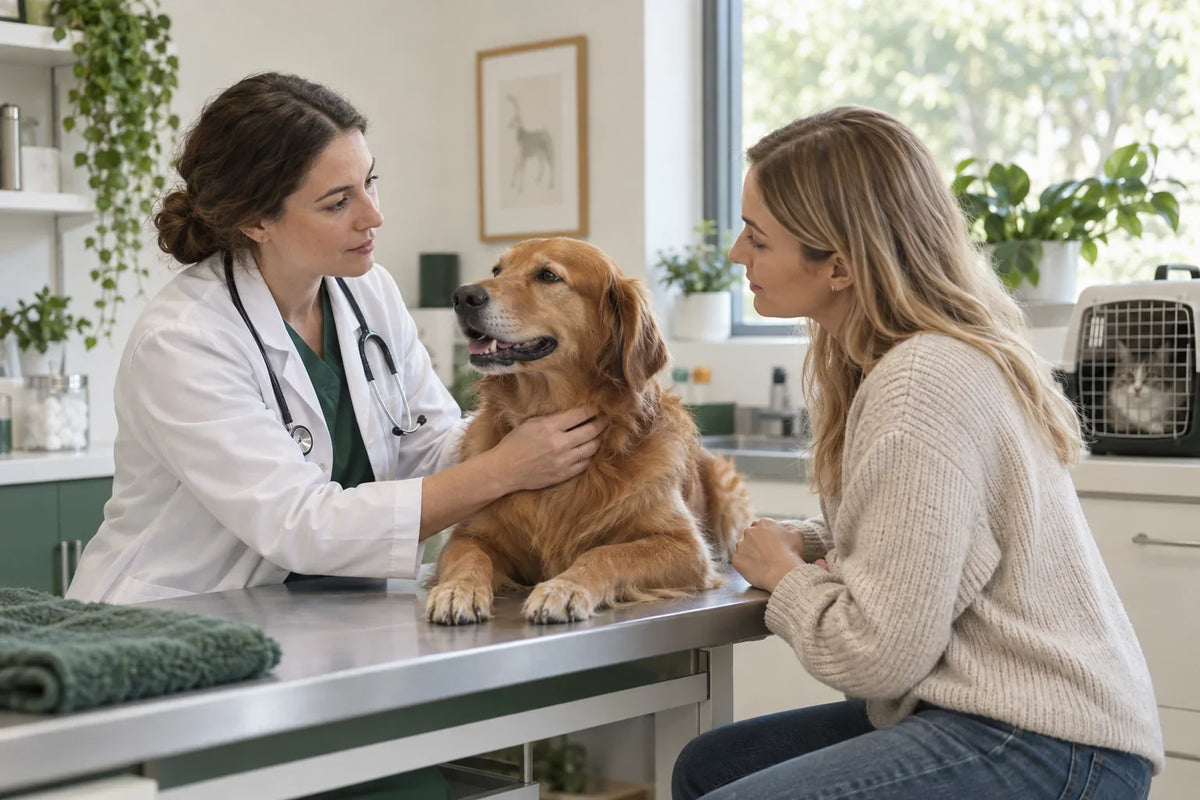
“Sensitive stomach” is one of the most common labels dog owners use — and one of the least specific. It usually describes a pattern: loose stools now and then, gassiness, a dog who skips meals, or the occasional upset after eating. None of those signs tells you why the stomach is upset. Calling it a sensitive stomach can feel like an answer, but it is really a description of symptoms that are waiting for a cause.
That cause matters because “sensitive” dogs are not all the same. One dog’s chronic looseness may come from a diet that is simply too rich for them; another may have parasites, a food allergy, or low-grade inflammation in the gut. Treating all of them with the same “sensitive stomach” food would miss the point. This guide walks through what to track before the appointment, what your veterinarian may investigate, and which feeding changes are worth trying — under veterinary supervision, not store-shelf guesswork.
“Sensitive Stomach” Is a Description, Not a Diagnosis
Before you buy another “gentle” formula, it helps to know what is actually on the table. A veterinary workup narrows the list. The table below shows directions a veterinarian may investigate — it is not a menu to diagnose from at home.
| What you might see | Direction a vet may investigate | Why guessing at home fails |
|---|---|---|
| Loose stools after certain foods | Dietary sensitivity or intolerance | Several foods could be the trigger; only a controlled trial tells you which |
| Itching or skin signs along with digestive upset | Food allergy or another allergy | Allergy diagnosis works by ruling out other causes first |
| Recurrent soft stool with normal energy | Parasites or bacterial imbalance | Fecal testing is needed; not all parasites are visible to the eye |
| Weeks of vomiting or diarrhea, weight loss | Chronic gut inflammation (such as IBD) | Conclusive diagnosis is based on tissue biopsy, not symptoms |
| Greasy, bulky stool with weight loss despite a good appetite | EPI — a shortage of digestive enzymes | Needs a vet test; treatment is veterinary-prescribed, not over-the-counter |
| Changes in thirst, urination, or appetite | Kidney, liver, or endocrine disease | Routine bloodwork can catch what food changes cannot |
Inflammatory bowel disease is a good example of why the label fails. VCA Animal Hospitals explains that IBD is a syndrome — a specific reaction to chronic irritation of the intestinal tract — and that the specific type is conclusively diagnosed based on tissue biopsies, after testing rules out parasites, infections, and other organ problems. Symptoms alone cannot separate it from simpler dietary upset, which is exactly why a dog with persistent signs deserves a workup rather than a new bag of food.
A Symptom Log Before the Vet Visit
A two-week log turns “he has always had a funny stomach” into information your veterinarian can actually use. Start it as soon as you notice a pattern, and keep it going until the appointment.
| Date | Stools (how often, form) | Meals and treats | Supplements or meds | Appetite and energy | Anything unusual |
|---|---|---|---|---|---|
Two habits make the log useful. Keep the diet stable while you record — if you switch foods right before the appointment, your vet loses the baseline. And note timing: did the loose stool follow a particular treat, a meal change, or a stressful event? Patterns like that are clues.
Feeding Changes That Are Worth Trying
When a workup has ruled out parasites, infections, and organ disease, diet becomes the main experiment. The word “hypoallergenic” on a bag does not make it so; veterinary food trials are structured. VCA notes that a true food trial requires the test diet to be fed exclusively for 8 to 12 weeks, with no treats or other foods, although improvement can appear in less than two weeks. Depending on test results, a veterinarian may choose an easy-to-digest gastrointestinal diet, a novel-protein diet, or a hydrolyzed diet — each works differently, and none should be picked by guesswork at the pet store.
If your vet approves a food change, make it gradual over at least a week, hold at the last comfortable mix if stools soften, and keep the log running. One controlled change at a time is the rule: food, treats, chews, and toppings all count. Home additions like plain canned pumpkin, boiled chicken, or rice can be fine in the short term, but they are not complete diets and can unbalance a meal plan if used daily — ask your vet whether an addition fits your dog, and for how long.
Supplements in Context
Pet-store shelves are full of “digestive support,” and two categories come up constantly: probiotics and digestive enzymes. Their roles are different. In dogs with chronic gut inflammation, probiotic and prebiotic supplements may help restore the balance of normal gut bacteria — VCA lists them among possible tools in IBD treatment. But probiotics do not replace the workup, and not every strain is the same. Digestive enzymes belong to a separate category: they are clearly useful mainly when the pancreas does not make enough of its own, a condition called EPI. VCA Canada explains that in dogs with EPI the veterinarian provides enzyme supplements as part of treatment — it is not a supplement decision an owner makes alone.
Red Flags That Stop the Home Experiment
Some digestive signs should never be managed with diet alone. Stop experimenting and call your veterinarian — or an emergency service after hours — if you see:
- Vomiting more than once in a day, or vomiting that continues
- Blood in the stool, fresh red or dark and tarry
- Weight loss, or a puppy who is not gaining
- Lethargy, weakness, or a painful abdomen (hunched posture, guarding, crying)
- Loss of appetite that lasts more than a day
- Mild signs that simply will not improve after two weeks of logging
These are the moments when the log doubles as the report to your vet. If you are not sure whether a sign is serious, the ten signs a dog needs veterinary care is a useful checklist.
The shortest route to a calmer stomach usually runs through the exam room, not the treat aisle. Track two weeks of symptoms, keep meals stable, let your vet run the tests, and ask which food trial — if any — fits your dog. “Sensitive stomach” is the start of a question, and your veterinarian is the person to finish it.