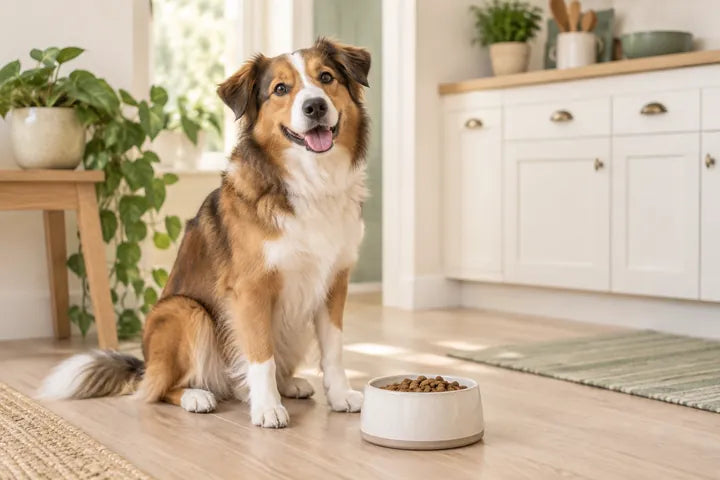
Dog gas causes are usually mundane and occasionally meaningful. Most flatulence reflects what is eaten, how quickly it is eaten, and what the colon does with the leftovers.
This is general education rather than a diagnosis. It explains the three pathways, what to change in order, and which findings turn a household annoyance into a veterinary question.

Dog gas causes: eating speed and bowl design
A dog that finishes a meal in under a minute swallows air with the food, and swallowed air has to go somewhere. Speed is the most common controllable cause of gas in otherwise healthy dogs.
Bowl design influences speed. Wide, shallow bowls are easier to gulp from than deep ones, and a bowl placed on the floor encourages faster eating than one raised to chest height for some dogs.
The fix is simple and testable, which is why it belongs first. A slow feeder, a scatter feed on a mat, or splitting the meal into two smaller portions all reduce how much air is swallowed, and most owners see a change within a few days. Competition makes it worse, so a multi-dog household benefits from feeding in separate spaces. If your dog eats fast because of anxiety about food being taken, address that as well, because the behaviour will continue regardless of bowl design. The gut community and its metabolic products also respond to diet, as studies in dogs describe (gut microbiome and diet), which is why speed is only the first question.
What do owners get wrong first?
Check eating speed before changing food.
A slow-feeder test takes a few days and costs very little, while a diet change takes weeks and introduces new variables, so the cheap test belongs first.
The second mistake is ignoring the treats, since a handful of a different product each day can produce more fermentation than the main meal. The third is switching food abruptly, because a sudden change itself causes gas and the owner concludes the new diet is worse. The fourth is adding several supplements, including probiotics and enzymes, before the diet is stable. Before changing anything, measure the meal size and how long it takes to eat, and list every treat and supplement with the amount, because the answer is usually visible in that list.
Which pathway fits your dog?
Three pathways cover most cases.
The pattern points to which one to work on, and the table below pairs each pattern with the first change worth testing.
| Pattern | Likely pathway | First change |
|---|---|---|
| Gas soon after meals, dog eats fast | Swallowed air | Slow feeder or scatter feed |
| Gas with soft stool or diet changes | Fermentation in the colon | Gradual diet review |
| Gas with treats, dairy or rich food | Specific ingredient | Remove one item and measure |
| Gas with weight loss or vomiting | Underlying condition | Veterinary assessment |
Fibre sits in the middle of this, because some fibres ferment and produce gas while others add bulk, and the amount matters as much as the type (dietary fiber review). Sudden changes in the gut community can also shift the gases produced, and studies comparing the microbiome and its metabolic products in dogs with digestive disease show how variable those changes can be (gut microbiome and metabolome in dogs).
What to change, in what order
Change one variable, measure, then decide.
First, slow the meal with a different bowl or a scatter feed, and keep everything else identical for a week. Second, remove the treat or the supplement that is most likely to be responsible and measure again.
Third, if nothing has changed, review the diet with your veterinarian and transition gradually over five to seven days, keeping the rest of the routine stable. Fourth, if gas continues after a fair trial on a stable diet, arrange an assessment rather than adding products, because a persistent change may reflect a digestive condition or a food reaction. Keep treats consistent, since the daily margin matters, and the site’s advice on how treats fit the daily total is worth reviewing. If a diet change is needed, the site’s guide to switching food without upset explains the transition.
What should you see, and when?
Speed changes show results in days.
If a slow feeder is the answer, gas should reduce noticeably within the first week, and if it does not, the cause is elsewhere rather than the bowl.
For a diet change, allow two to three weeks before judging, and keep the transition gradual so any softening of the stool is not mistaken for a reaction to the new food. Record gas frequency, stool quality, and appetite so you can see a trend rather than reacting to one bad evening. If gas improves but stool becomes softer, the fibre or fat content may need adjusting with advice rather than more changes at home. Where a supplement is being considered, treat it as a separate change, and the site’s guide to choosing a probiotic explains what a label should state.
When does gas need a vet visit?
Book an appointment if gas comes with weight loss.
Seek emergency care for a sudden, swollen, painful abdomen, especially in a large-breed dog, because that combination is not ordinary flatulence.
Bring a week of notes, the diet, and the list of treats and supplements, then ask whether a diet trial, a stool test, or another investigation is appropriate. Ask what the plan is if the first change does not help, and ask whether the pattern suggests a food reaction rather than a digestion problem. Where a diet change is recommended, follow the transition and measurement advice rather than changing brands repeatedly. Labelling rules for these products vary by market, and AAFCO consumer material explains how pet food claims are framed.
What to record and review
Keep a short daily note for two weeks.
Record gas frequency, stool score, appetite, and the timing of meals, then note any change with the date and what else changed at the same time.
A pattern across two weeks is enough to tell whether the cheap changes worked, and it prevents the cycle of switching products without evidence. If the problem resolves, keep the change that fixed it, and note it explicitly, because gas often returns when a slow feeder is swapped back. If you eventually need an appointment, the same page saves time and gives the clinic a clear history. The Merck Veterinary Manual covers the gut conditions that can present with gas alongside other signs, and the site’s FAQ answers common questions about feeding and digestion.

If you want the wider framework for judging gut products, read the site’s pet supplement safety guide.
FAQ
What causes excessive gas in dogs?
Three common causes are swallowed air, eating too fast, and fermentation of nutrients in the colon. Diet composition, a sudden food change, treats, and some ingredients such as certain fibers or dairy also contribute. Less often, gas accompanies a digestive condition that needs assessment. Because the cause decides the fix, a food diary for a week is more useful than trying several products.
Does a slow feeder help with dog flatulence?
It can, if your dog eats quickly and swallows air. A slow feeder or a scatter feed spreads the meal over longer, which reduces swallowed air and often reduces gas within days. The change is easy to test, requires no dietary change, and produces a clear answer, which makes it a sensible first step before altering the food.
Should I change my dog’s food for gas?
Change one thing at a time and only after measuring. If speed and treats are not the cause, a gradual diet change is reasonable, and the new diet needs two to three weeks before you judge it. Sudden changes can cause gas themselves, which is why a several-day transition matters. If gas continues after a fair trial, an assessment is a better next step than another brand.
When is dog gas a sign of a problem?
Gas deserves attention when it comes with weight loss, vomiting, diarrhoea, a bloated or painful abdomen, a change in appetite, or when it is severe and persistent despite a stable diet. A suddenly distended abdomen in a large-breed dog is an emergency rather than a digestive complaint. Otherwise, occasional gas is normal and usually responds to management changes.