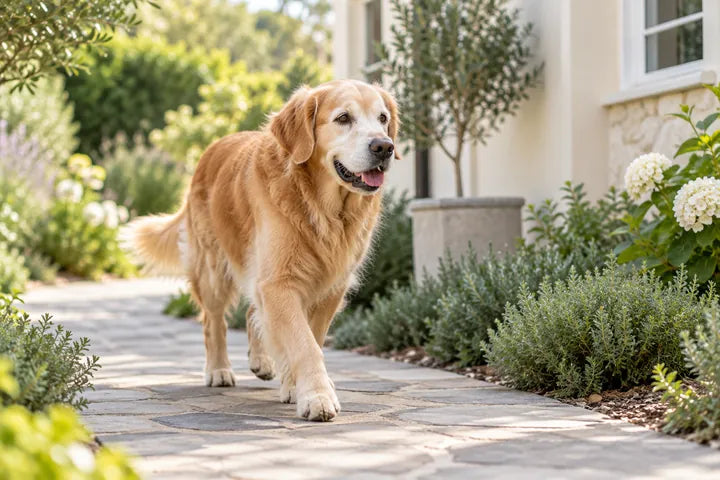
Track mobility dog owners can repeat is the missing piece in most joint care plans, because without a method every change is judged against memory. Owners remember the worst days and forget the good ones, which makes it almost impossible to tell whether anything is helping.
This is general education rather than a scoring standard. It explains how to choose measures, how to keep scoring consistent, and how to interpret what the log shows. Movement logs are one part of our guide to joint health for dogs and cats, alongside ingredient reading and changes around the home.

Track mobility dog: choosing two or three measures
Pick measures that are visible in daily life and easy to score. Distance walked before slowing, willingness to take the stairs, and how long it takes your dog to rise after rest cover most of what matters. The early-signs article provides another starting point: early changes in movement.
Add whether your dog still asks for walks, because a dog that stops asking is showing a functional change even if they move normally when taken out.
Two or three measures are enough, and using more usually means abandoning the log within a month. Define each score in advance so you are not deciding what a three means while standing in the garden: for example, zero for refuses, one for hesitates, two for completes slowly, three for completes normally. Write the definitions at the top of the page. If your dog has a specific problem, such as difficulty on slippery floors or reluctance to jump onto a favourite surface, include that behaviour as one of your measures. Clinical guidance recommends structured observation for assessing pain in animals, which is the reasoning behind scoring rather than simply watching (2022 AAHA pain management guidelines).
What makes a measure repeatable?
Repeatability depends on constant conditions.
Same route, same surface, same time of day, and the same person walking the dog, because a different handler or a busier street changes the result as much as the joint does.
Apply the same logic to video: film from the same position, at a similar distance, and on the same flooring, so the walking surface and the camera angle do not change the impression. Repeatability also means resisting the urge to add new measures mid-way, because a measure introduced in week three has no baseline. Keep the scale coarse, since eight-point scales are harder to apply consistently than four-point ones. Finally, write the notes in the same place each time, whether that is a notebook by the door or a note on your phone, because a log that is spread across three places will not survive a busy month. Lameness scoring varies between observers in clinical settings, which is exactly why your own consistent method, in the same conditions each week, is valuable (lameness examination study).
Video, timing and scoring ranked by effort
The elements of a good record cost different amounts of effort.
| Element | Effort | What it adds |
|---|---|---|
| Daily score of two measures | Very low | Shows variation and trend |
| Weekly walking video | Low | Shows gait change to a clinician |
| Rise time after rest | Low | Captures stiffness that walking hides |
| Body condition and weight monthly | Moderate | Links load to the measures |
| Photo set from two angles monthly | Moderate | Tracks muscle loss over months |
Start with the first two rows and add more only if you will keep them up. Environmental context belongs in the same page: weather, surfaces, any change in food or medication, and any new activity. Joint disease progresses slowly, so the trend across months is more informative than any single week, and the Merck Veterinary Manual explains the condition your measures are describing.
Starting your log this week
Write the page before you start scoring. At the top, put your dog’s name, the date, and the definitions for each score. Then add columns for the date, the measures, and a short notes field.
Score for a week before changing anything in your dog’s routine, because a baseline taken after you have started a new product or a new exercise plan tells you almost nothing.
Choose a time of day that fits your routine, such as after the morning walk, and score then rather than whenever you remember. Film one short clip a week, keep the files with dates in the names, and do not delete the early ones, since they become your reference. Add a monthly weight and body condition score if your dog will tolerate handling, and note any change in medication or diet in the same place. If your dog has a bad day, record it and record why, because an identifiable cause explains a dip that would otherwise look like a decline. For dogs also receiving joint products, the log is what makes a trial meaningful, and the site’s guide to choosing a joint supplement explains how to set the outcome first.
When should the log trigger a vet call?
Call when a measure drops for two weeks.
Also call if your dog stops using stairs, stops asking for walks, or takes noticeably longer to rise after rest, because those are functional changes rather than fluctuations.
A sudden change needs prompt attention, since nerve, spinal, and injury problems can present as a rapid loss of mobility. Bring the log to the appointment, along with the videos, and state the change in numbers: what the score was, what it is now, and over how long. Ask whether pain management needs adjusting, whether your dog’s weight is playing a role, and whether a rehabilitation referral would help. If you are trialling a product, agree a review date in advance, so the decision follows from the record rather than from a general impression. Owner-level material on age-related joint changes is available from the Cornell Riney Canine Health Center, and rehabilitation guidance describes how measured function guides treatment in dogs with joint disease (physical rehabilitation for hip dysplasia).
Reviewing the log after six weeks
Look at the trend rather than the last entry.
A six-week view shows whether scores are stable, improving slowly, or slipping, and it separates a noisy week from a real change in your dog’s mobility.
If scores have improved, note what changed in the same period and keep it in place, rather than adding a second change on top. If they have not, the plan needs a decision, which may mean adjusting pain management, reviewing weight, or changing the way exercise is structured. If they have declined, book an appointment sooner rather than extending the log. Keep the record going after the review, because a long-term picture helps at each appointment and protects you from the assumption that a change is simply age. Where supplements are part of the routine, judge them against the same scores, and the site’s guide to assessing a joint product covers the details.

If you want the wider framework for judging a joint product against your own records, read the site’s pet supplement safety guide.
FAQ
What should I measure to track my dog’s mobility?
Choose two or three measures you can observe without equipment: distance walked before slowing, willingness to use stairs, time taken to rise after rest, and whether your dog asks for walks. Add a weekly video of walking on the same surface. Fewer measures recorded consistently are far more useful than a detailed list you cannot keep up with, and consistency is what makes the comparison valid.
How often should I record mobility scores?
Score daily if you can, and record a summary each week alongside a short video. Daily scoring captures variation, while the weekly summary shows the trend without being distorted by one bad day. If daily scoring is unrealistic, twice a week at the same times will still reveal a change over a month. The important part is to use the same measure, the same scale and the same conditions each time.
Should I measure or just watch my dog?
Both, but measurement is what makes the observation usable. Watching tells you that something feels different, while scoring tells you whether it is different from last month and by how much. Structured observation is the approach clinical guidance recommends for assessing pain in animals, precisely because impressions change with mood and context. A score plus a video is enough to make a veterinary conversation concrete.
What changes in the log should prompt a vet call?
Call if any measure declines clearly over two consecutive weeks, if your dog stops using stairs or stops asking for walks, if stiffness lasts longer after rest, or if a change appears suddenly rather than gradually. Also call if your dog seems painful when handled, or if the decline continues despite treatment. A worsening trend is easier to act on early, and the log is what makes the trend visible.