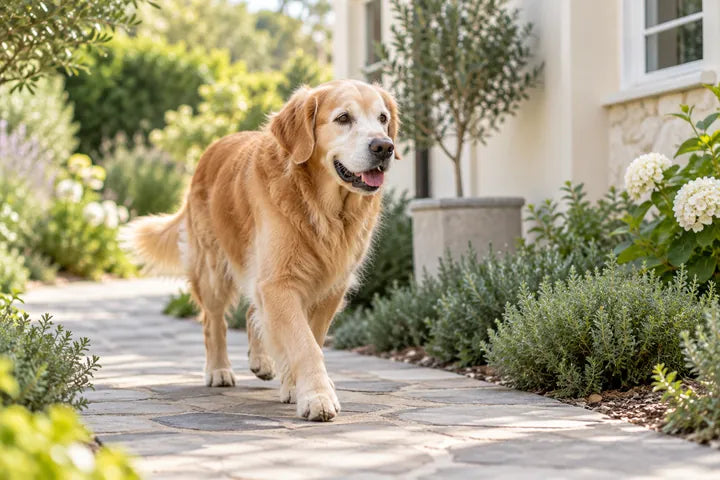
Senior dog mobility home improvements usually begin with shopping for a ramp or a new bed, and the most common limiting factor is the floor. A dog that slips on tile or hardwood stops using that route long before it stops being able to walk.
This is general education rather than a diagnosis. The audit below walks through a home in the order that produces the most change for the least effort, and it ends with the signs that mean an examination instead. This home review is part of our wider reading route on joint health for dogs and cats.

Senior dog mobility at home: floor traction comes first
Slipping changes behaviour. A dog that loses grip once starts to walk slowly, avoids corners, and eventually refuses the room, and the loss of confidence reduces activity, which reduces strength.
Traction is therefore the first fix rather than a cosmetic one, because it restores the dog’s ability to move around the house independently and safely.
Practical options include non-slip runners along the main routes, mats at the bottom of stairs and by food and water bowls, and rugs secured with anti-slip underlays. Nail length matters here too: long nails reduce contact with the floor and make slipping more likely, and a grip harness with a handle can help you assist without lifting the whole body weight. The routes to check are the ones your dog uses daily: the corridor to the back door, the path from bed to water bowl, and any doorway where the flooring changes. Fix those first and you will often see a change in movement within days. For context on how joint disease is assessed and managed, the Merck Veterinary Manual describes degenerative joint disease in dogs.
What should you measure before you change anything?
Take a baseline for one week before you buy anything.
Count the daily things your dog does or avoids, because those numbers show whether your changes helped and prevent you from spending money on equipment your dog did not need.
Useful measures include how many times a day your dog uses the stairs, whether they ask to go out in the evening, how long they take to get up after resting, and whether they still jump onto furniture or into the car. Add a short walking video every week, filmed on the same surface and from the same angle, and note the surfaces involved. If your dog is stiff for a few steps after rest and improves with movement, that pattern is worth recording, because it is different from stiffness that never settles. Also record weight and body condition if you can, since extra weight changes the load on every joint, and the Association for Pet Obesity Prevention provides body condition resources for owners.
Room by room: where senior dogs struggle
Different rooms create different obstacles, and most homes have three or four recurring problems rather than a dozen. The companion equipment guide covers ramps, stairs and car access.
The kitchen usually means hard flooring and tight turns around bowls; the living room means sofa height and low furniture; the hallway means a long, smooth run; and the bedroom means bed height and a floor that may be colder or more slippery than expected.
Outside, the common issues are steps at the back door, uneven patio surfaces, and a garden that requires crossing rough ground. The car is a room-sized problem of its own, and it is often the first one owners notice, because jumping into a boot becomes difficult before walking does. Walk through your home with a notepad and record three things for each space: the surface, the height change, and the distance your dog has to cover. Then rank them by how often your dog uses that route. This ranking is what stops owners from buying a ramp for a dog that never used it, while the floor by the back door remains untreated. Physical rehabilitation guidance for dogs with joint disease emphasises function and environment together, which is the reasoning behind this audit (rehabilitation of hip dysplasia in dogs).
What can you change this week?
Most changes take an afternoon.
Keep the changes in fixed positions, because a dog that has learned a safe route will not re-check it every time, and moving mats creates new uncertainty.
Move bowls closer to your dog’s main resting area if the walk is long, and consider two water stations if your dog is reluctant to cross hard flooring. For the car, a stable ramp or a set of steps that stay in the same place works better than lifting, which can be unsafe for both of you, and a support harness helps if your dog needs assistance. Introduce new equipment with treats and short sessions, and let your dog choose to approach it. Nail care and coat care belong in this list too, because long nails affect grip and matted fur in the groin area can make walking uncomfortable. For a full routine, the site’s guide to senior dog mobility at home covers daily habits that sit alongside these changes.
When is this a vet conversation instead?
Home changes support comfort only.
Book an appointment if your dog is reluctant to move at all, is stiff for more than a few minutes after rest, has stopped using stairs or the car, has lost muscle along the spine, or has changed mobility suddenly rather than gradually.
Sudden changes in particular need prompt attention, since a dog that cannot use a hind limb, drags the toes, or knocks over the back feet may have a nerve or spinal problem rather than arthritis. Older dogs also commonly have dental pain, which reduces eating and activity, and both issues are easier to treat when found early. Ask about pain assessment specifically, because owner reporting and clinical assessment are complementary rather than interchangeable, and structured observation is the method recommended in clinical guidance (2022 AAHA pain management guidelines). If your veterinarian prescribes medication, ask how long before you should see a change and what monitoring is needed, since older dogs often have other conditions that affect drug choice.
How do you know the changes worked?
Compare the same measures again.
Improvement usually shows up as increased willingness rather than as a dramatic change in gait: using the stairs again, asking to go out, standing up more quickly, or choosing the room with the new runner.
If nothing has changed after two or three weeks of consistent measures, the limit may not be environmental, and that is a useful finding for your veterinarian. If things are worse, treat it as a reason to book an appointment rather than to add another product. Keep the photographs and weekly videos in one folder so the comparison is visible, and review the whole plan when the seasons change, since cold weather often affects stiff joints and outdoor routes become less predictable. For dogs also taking supplements, the site’s guide to choosing a joint supplement explains how to assess what you are giving, and the Cornell Riney Canine Health Center is a useful owner-level reference for age-related conditions.

If you want the wider picture of what changes with age, the site’s FAQ covers the questions owners ask most often about older pets.
FAQ
What is the first thing to change for a senior dog with mobility problems?
Floor traction. Slipping is the most common reason an older dog stops moving around the house, and non-slip runners on the routes your dog uses most often cost little and change behaviour quickly. Traction addresses confidence as well as safety, because a dog that expects to slip on a hard floor will often stop walking on it altogether, which then reduces strength and makes the problem worse.
How do I know if my senior dog is in pain rather than just slowing down?
Look at function rather than mood. A dog that hesitates before jumping, lands heavily, avoids stairs, stands with a hunched back, or stops asking to go out is showing a change that deserves assessment. Clinical guidance recommends structured behavioural observation rather than relying on crying, because dogs rarely vocalise when they are sore. A veterinary assessment is the only way to separate arthritis, dental pain, and other causes.
Do ramps and harnesses really help?
They help when they remove a specific obstacle the dog faces daily, such as getting into a car, climbing three steps, or getting onto a favourite sofa. A ramp that is too steep, too narrow, or unstable will be avoided. Introduce any new piece of equipment slowly, with treats and short practice sessions, and keep it in the same place so your dog can rely on it. Ask your vet whether a support harness is appropriate before lifting.
When should home changes be replaced by veterinary treatment?
Home changes should sit alongside veterinary care, not replace it. Book an appointment if your dog is reluctant to move, is stiff for more than a few minutes after rest, has stopped climbing stairs or jumping into the car, has lost muscle along the spine, or has had a sudden change in mobility. Pain management in older dogs has real options, and the assessment is what makes them available.