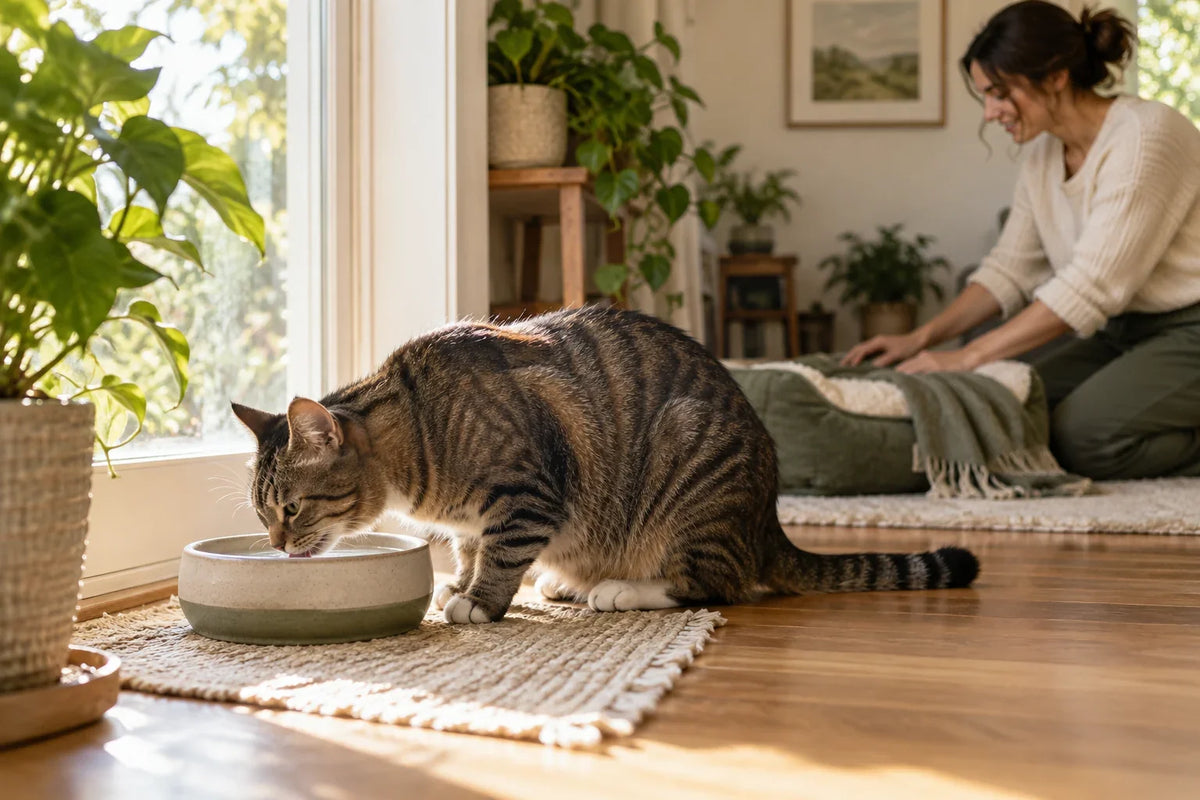
New cat introduction stress is the most predictable part of adopting a second cat, and it is also where most households go wrong. Cats are territorial and social in a specific way, and mixing two unfamiliar cats immediately sets up the conflict rather than avoiding it.
This is general education rather than a behaviour programme. It explains why the process takes weeks, what to watch in each cat, and how to build a home where several cats can coexist comfortably.

New cat introduction stress: why slow introductions are not optional
Cats build confidence from control over their environment. A new cat removes some of that control, and the resident cat’s response is to defend space, resources, and routine.
Slow introductions work by giving both cats separate territory first, then controlled exposure at a distance, so each experience stays below the level that triggers a fight or a retreat.
The alternative, letting them sort it out, produces hiding, spraying, litter box avoidance, and sometimes injuries, and the resulting fear is much harder to undo than a relationship that developed slowly. Feline social behaviour is more complex than the common assumption that cats are solitary, and veterinary resources describe how cats organise themselves socially (normal social behaviour in cats), while problem behaviours in cats have their own entry (behaviour problems in cats). Research on domestic cats also shows measurable behavioural and physiological responses to stressors, which is why the pacing of introductions matters (stressors in domestic cats).
What should you measure before you change anything?
Measure each cat separately.
Record where each cat spends time, whether either is hiding more than usual, how much each is eating, whether litter box use has changed, and whether grooming, vocalising, or play has changed.
Add the specific conflict signals: staring, blocking doorways, chasing, hissing, and who uses which resources. Note the times of day when tension is highest, because mornings and evenings often follow a pattern that a routine can address. Keep a simple chart for a week, and photograph the setup, including where the litter boxes, food, water, and resting places are, because resource layout is usually where the problems are. If either cat is unwell, that changes everything, and a cat that is not eating or is hiding continuously needs a veterinary check rather than a behaviour adjustment.
Which steps matter most in the first month?
The first month is about space and resources.
Friendship is not the early goal, and the stages below build tolerance by keeping both cats confident while they share a home.
| Stage | What to do | What to watch for |
|---|---|---|
| Week one | Separate rooms, separate resources, scent swapping | Eating, litter use, hiding |
| Week two | Controlled sight through a barrier, feeding on either side | Eating calmly near the other cat |
| Weeks three to four | Short supervised time in the same room with exits available | Staring, blocking, chasing |
| Ongoing | Duplicated resources in separate places | Competition at boxes and bowls |
Provide one litter box per cat plus one extra, in separate locations, and duplicate food and water stations so no cat has to pass another to eat. Add vertical space, since height gives cats a way to be in the same room without conflict, and provide hiding places with more than one exit. Feline welfare organisations publish practical household guidance, including International Cat Care, and clinical practice guidance on feline environmental needs is available from the American Association of Feline Practitioners. If signs escalate, slowing down is more effective than pushing forward, and a behaviour professional can help with a structured plan.
What to do this week
Start with separation and scent. Give the new cat a room with everything they need, let the resident cat keep the rest of the home, and swap bedding between the rooms so each learns the other’s smell.
Then set up feeding on either side of a closed or screened door, starting far enough apart that both cats eat calmly, and move the bowls closer over days rather than hours.
Once both cats eat comfortably at a short distance, allow brief visual contact through a barrier with a screen or a gate, and end each session while both are relaxed. Then try short, supervised time in one room with multiple escape routes and no dead ends. Keep sessions brief and stop before tension appears, and never punish a cat for hissing, because that adds fear to an already stressful situation. Keep the resident cat’s routine unchanged where possible, including play and one-to-one time. If a cat needs medication for an unrelated condition, the site’s guides to pilling a cat and giving liquid medicine make that easier to manage during a stressful period.
When does stress need veterinary help?
Involve a vet if a cat stops eating.
Also involve one if there is spraying, overgrooming, wounds from a fight, or if one cat is being blocked from food and water, and if the tension has not reduced after several weeks of careful introductions.
These signs can also indicate medical problems, which is why an examination comes before assuming the cause is behavioural. Bring your chart and describe the setup, including resources and locations. Ask whether a behaviour referral is appropriate, and ask about pheromone products or other aids, since some households find them useful as part of the plan rather than as a solution on their own. If the new cat came from a shelter or a multi-cat environment, mention that history, because it may influence how the introduction should proceed.
Reviewing whether the household settled
Measure the relationship over weeks rather than days.
Progress looks like both cats eating normally, using their litter boxes reliably, sharing space without tension, and gradually increasing the time they spend in the same room without conflict.
Peaceful distance is a good outcome, and expecting friendship is not realistic for every pair. If progress has stalled, slow the process down, review the resource layout, and consider professional help rather than allowing daily tension to continue. Keep the duplicated resources permanently, since removing them once things improve is a common reason for relapse. For households where the stress shows up as changes in appetite or grooming, the site’s article on subtle signs in cats explains why quiet changes deserve attention, and the site’s FAQ answers common questions about feline care.

If you want the wider view of feline care, the site’s FAQ answers the questions owners ask most often.
FAQ
How long does it take for cats to accept a new cat?
Weeks to months, and it depends on the individual cats rather than on a schedule. Slow introductions with separate resources and controlled sight and scent contact produce better outcomes than immediate mixing, and rushing usually creates conflict that is harder to resolve later. Some cats become comfortable friends, others reach a peaceful coexistence, and both of those are acceptable results for a household.
Should I let them sort it out themselves?
No. Cats are not pack animals and do not resolve conflict the way dogs sometimes do. Letting them work the relationship out usually produces hiding, spraying, litter box avoidance, and in some cases injuries or lasting fear that takes months to undo. Structured introductions with separate resources and controlled contact let each cat stay confident while the relationship develops at a manageable pace.
What are the signs the introduction is going badly?
Watch for hiding for most of the day, refusing food, spraying or marking, avoiding the litter box, overgrooming, and one cat blocking another from resources. Staring, blocking doorways, and chasing are signs that contact is moving too fast. If any cat stops eating or starts eliminating outside the box, slow the process down and speak to your veterinarian.
How many litter boxes do I need for three cats?
The usual guidance is one box per cat plus one extra, placed in different locations rather than lined up together. Each box should be easy to reach, in a quiet spot with more than one escape route, and scooped daily. Cats avoid areas where they feel trapped, and resource competition is one of the most common reasons for litter box problems in multi-cat homes.