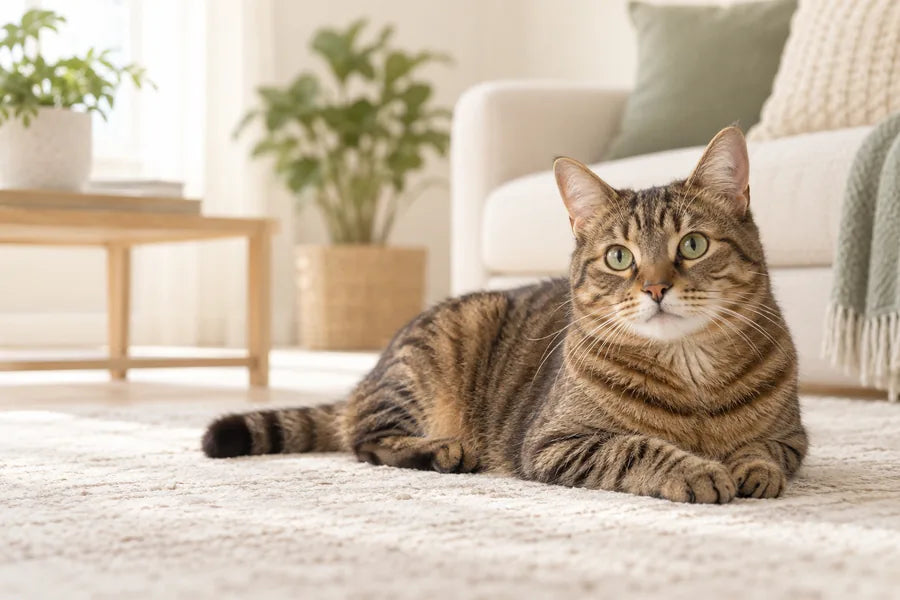
Feeding multiple cats works when each cat’s intake can be measured, and fails when it cannot. A shared bowl removes the single most useful piece of information you have about a cat’s health.
This is general education rather than a diet plan. It explains how to set up stations, prevent stealing, and monitor each cat without turning mealtimes into a conflict.

Feeding multiple cats: why competition changes everything
Cats are not communal feeders, and a row of bowls along one wall invites competition. A faster or more confident cat finishes first and then investigates the next bowl.
The consequence is that intake becomes unmeasurable. One cat eats more than intended, another eats less, and the owner sees two empty bowls and concludes that both are fine.
That loss of information matters most when something changes: a cat that is unwell often reduces intake before showing any other sign, and a shared bowl hides it. Nutrition for cats is covered in the Merck Veterinary Manual, and environmental needs around feeding are described in feline practice guidance (AAFP practice guidelines). The behaviour that develops around competition is a recognised feline problem area (behaviour problems in cats).
What do owners get wrong first?
Free-feeding a shared bowl is the first mistake.
It is convenient and it makes portion control, diet changes, and illness detection impossible, which costs far more than the time it saves.
The second mistake is putting all the stations together, because a single location creates a bottleneck and lets one cat control access to every bowl at once. The third is assuming that a cat which is being blocked will look thin, when weight loss in cats can be hidden by coat and posture for weeks. The fourth is changing the arrangement only during mealtimes, so the cats never have time to establish calm expectations about the space. Before changing anything, weigh each cat and observe one meal closely from a distance.
Which setups prevent competition?
Three arrangements work in most homes.
Separate rooms with the door closed suits cats on different diets, timed feeding suits cats that eat promptly, and microchip feeders suit homes where separation at mealtimes is impractical.
| Setup | Works when | Practical note |
|---|---|---|
| Separate rooms at mealtimes | Cats on different diets | Bowls lifted afterwards |
| Timed meals in the same room | Cats eat promptly and calmly | Stations apart, with sightlines |
| Microchip feeders | Cats need access to different food | Needs training and cleaning |
| Elevated or separate water stations | Always useful | Keep away from food and litter |
Feeding stations should be placed with a clear approach and an exit, and away from litter boxes, since cats avoid resources that are next to a toilet area. If a cat needs a different diet, that is a reason for separation rather than for mixing bowls and hoping, and the site’s comparison of wet and dry food for cats explains how format affects intake when one cat needs a specific diet.
What to change, in what order
Change the arrangement before changing the food.
First, measure what you currently put down in total and compare it with what each cat needs, then decide whether separation is required.
Second, set up separate stations with clear sightlines and no dead ends, and start feeding at fixed times rather than leaving food out all day, since a predictable schedule reduces competition between cats. Third, lift the bowls afterwards, and if one cat eats slowly, feed that cat in a room with the door closed. Fourth, if separation is impractical, consider a microchip feeder and train each cat to it. Where a cat needs medication with food, the site’s guide to pilling a cat explains how to keep the dosing reliable, and handling guidance from International Cat Care covers the wider routine.
What should you measure, and when?
Measure each cat, not the bowl.
Weigh every cat monthly on the same scale, score body condition by hand, and record how much each cat is offered and, where possible, how much is eaten.
Add observations about mealtime behaviour: who finishes first, who leaves the area, and whether anyone is hovering or blocking a doorway. Those details explain the numbers, and they are often the first things to change when a medical problem is developing in one cat. Growth or weight change outside the expected range is a reason to book an appointment rather than to adjust the arrangement again. Cats with joint pain may also eat less comfortably from a low bowl, and the site’s article on stiffness in cats explains why that possibility deserves a check.
What if one cat needs a different diet?
Treat a different diet as a reason to separate.
Therapeutic diets work through specific nutrient levels and amounts, so a cat eating the wrong food is not receiving treatment, and a healthy cat eating a therapeutic diet is receiving an unnecessary adjustment.
Ask the clinic whether the diet is time-critical, what to do if the cat refuses it, and whether mixing two diets is ever acceptable in your household. Ask also who should eat where, so the arrangement is decided in advance rather than improvised at mealtimes. Transition therapeutic diets as instructed rather than gradually at home, because those diets often need to be introduced quickly. If a cat refuses a new diet for more than a day, that is a clinical concern rather than a preference, and the clinic should be told rather than left to assume the transition went smoothly.
What to record and review
Keep one page per cat.
Record weight, body condition, the food offered, the treats, and any mealtime observations, then review each cat individually rather than as a group.
That per-cat record is what makes a change in one cat visible while the others stay stable, and it is the fastest way to answer a veterinarian’s questions about appetite and weight. If the arrangement changes, note the date, since cats often need a few days to settle into a new routine before the new setup can be judged.

Label and feeding conventions for cat food vary by market, and AAFCO consumer material explains how claims and feeding directions are framed.
If you want the wider view of feline care, the site’s FAQ answers the questions owners ask most often.
FAQ
How do I stop one cat eating another cat’s food?
Separate the cats at mealtimes, supervise until the bowls are lifted, and pick up anything left behind. If separation is impractical, microchip-controlled feeders allow each cat to reach only its own portion. Free-feeding makes sharing inevitable, and sharing makes it impossible to know how much any individual cat is eating, which matters for weight and for monitoring illness.
How many feeding stations do I need for three cats?
At least one station per cat, placed in different locations with clear sightlines and an escape route for each. Stations in a row along one wall create competition, because a cat can be blocked from approaching. Food and water should also be separated from litter boxes, and water stations are often best placed in several rooms.
Is it normal for cats to eat at different speeds?
Yes, and the difference is one of the main reasons shared feeding fails. A fast eater will finish and move to the slower cat’s bowl, and the slow cat then eats less without any obvious sign. If one cat needs a different diet or a different amount, that difference is the signal to separate the stations rather than to wait and see.
How do I know if a cat in a multi-cat home is not eating enough?
Monitor weight, body condition, and behaviour rather than the food bowl. Weigh each cat monthly on the same scale, check the spine and ribs by hand, and watch for changes in grooming, activity, or litter box habits. A cat that is being blocked from food usually loses condition before it shows any obvious sign, so weighing is the most reliable measure available at home.