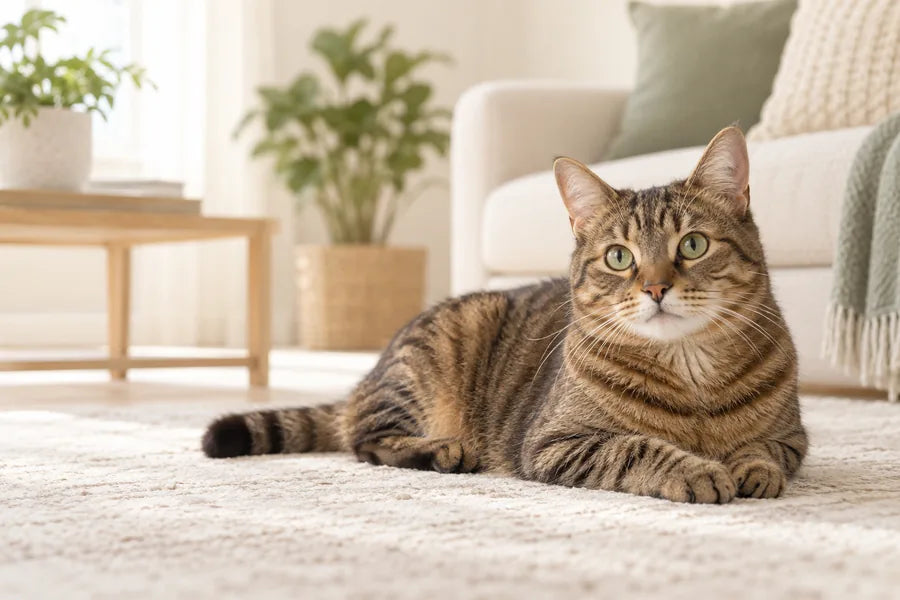
Cat not using litter box is usually described as a behaviour problem and often has a physical cause. Pain, box design, litter type, cleaning routine, and household changes all produce the same result.
This is general education rather than a diagnosis. It sets out the order of checks, explains why medical causes come first, and shows what to measure while the environment is adjusted.

Cat not using litter box: what to rule out first
Medical causes come first because they are common and because some are urgent. Urinary tract disease, bladder stones, kidney problems, and digestive pain all change litter box behaviour.
Joint pain matters too, since a cat with sore hips may struggle to step into a high-sided box or to adopt the posture, and the avoidance looks behavioural from a distance.
For that reason, a cat that has started eliminating outside the box should be examined before the situation is treated as a training issue. Behaviour problems in cats, including elimination outside the box, are covered in the Merck Veterinary Manual, and the feline urinary and kidney material describes how disorders in that system are detected (detecting disorders of the kidneys in cats). Where the cause turns out to be pain, treating it resolves the behaviour in many cases without any environmental change at all.
What do owners get wrong first?
Assuming the cat is being spiteful is the first mistake.
Cats do not act out of revenge, and treating the behaviour as a discipline problem delays the diagnosis of a cause that may be painful.
The second mistake is changing everything at once, including the box, the litter, and the location, which leaves no way to know what helped. The third is punishment, which adds stress and often makes the behaviour more frequent. The fourth is cleaning with strong ammonia-based products, which smell like urine and can encourage the cat to return to the same spot. Clean thoroughly with an enzymatic cleaner, and address the cause rather than only the evidence, because a spot that still smells of urine will keep attracting the cat back to the same place.
Which checks come before behaviour?
Work through the physical list first.
Check for straining, small or frequent urination, blood, vocalising in the box, appetite change, weight loss, or stiffness when jumping, and book an appointment if any of those are present.
| Check | What to look for | Why it matters |
|---|---|---|
| Urination pattern | Straining, small volumes, frequency | Urgent if no urine is produced |
| Box design | Size, sides, cover | High sides are hard for sore cats |
| Litter | Scented, coarse, or recently changed | Cats often prefer fine, unscented litter |
| Cleaning | Frequency and products used | Ammonia smells encourage repeat use |
| Location | Traffic, other pets, dead ends | Cats avoid boxes with one exit |
Research on litter box preference has examined choices such as covered versus uncovered boxes and different litter types, and the findings support offering options rather than assuming (litter box preference in domestic cats). Reviews of unacceptable indoor elimination describe the combination of medical and environmental factors involved (unacceptable indoor elimination in cats), and the Merck Veterinary Manual covers providing a litter box.
What to change, in what order
Change one thing at a time, starting with the cheapest tests.
First, clean the box more often and switch to an enzymatic cleaner for soiled spots, and add a second box in a quiet location with more than one exit.
Second, if the box has high sides, try a lower one, and if the litter is scented or coarse, offer an unscented fine litter in a second box rather than replacing the first, so the cat can choose rather than being forced to accept a change. Third, address competition in a multi-cat home by placing food, water, and litter resources in separate rooms, since a cat that is blocked from a box will find somewhere else to go and that spot becomes a habit. Fourth, if nothing changes, or if any medical sign is present, book an appointment. Feline practice guidance recommends one box per cat plus one, and the AAFP practice guidelines describe environmental needs in detail.
What should you measure, and when?
Measure both the box and the cat.
Record which box is used, how often it is soiled, where accidents happen, urine volume and frequency, appetite, and any signs of discomfort, then compare the same week-to-week measures.
That record is what tells you whether a change worked, and it is also the history a veterinarian needs, since the location of accidents often indicates whether the problem is urinary, digestive, or environmental, and the pattern of small frequent urination differs from a single accident in a new place. If accidents stop, keep the changes in place for several weeks before relaxing them, because cats revert quickly when a preferred box disappears.
When does it need urgent veterinary care?
Call immediately if no urine is produced.
Seek same-day care for blood in the urine, vomiting, a painful abdomen, a cat that cannot settle, or a sudden change in behaviour.
For less urgent presentations, book an appointment rather than continuing with environmental changes alone, because the cause needs to be identified and a urine sample is often part of that process. Bring your record, and ask whether a urine sample would help, since collecting one at home in a clean container is often possible. Owner-level feline guidance on litter boxes and household management is also available from International Cat Care.
What to record and review
Keep a daily note for two weeks.
Record litter box use, accidents with their location, urine and stool, appetite, water intake, and any new stressor such as a visitor or a change in routine, then review the whole page at the end of the fortnight.
If the problem resolves, keep the additional box and the cleaning routine rather than returning to the original setup, because the environment was part of the answer. If it does not, the pattern you recorded shortens the diagnostic process considerably.

Where a cat has been treated for a urinary problem, keep monitoring for a few weeks afterwards, because recurrence is common and early signs are easy to miss.
If you want the wider view of feline care, the site’s FAQ answers the questions owners ask most often.
FAQ
Why has my cat stopped using the litter box?
The most common reasons are medical or environmental rather than behavioural. Pain from urinary or digestive problems, a box that is too small, dirty, covered, or in a busy location, and changes in the household all cause avoidance. Because urinary problems can become serious quickly, a cat that strains or urinates outside the box should be examined before the problem is treated as behaviour.
How many litter boxes should I have for two cats?
The usual guidance is one box per cat plus one extra, placed in separate locations rather than side by side. Boxes should be easy to reach, quiet, and have more than one escape route. Cats also prefer different types of litter and box styles, so offering a choice and observing which one is used tells you more than changing everything at once.
Should I change the litter type if my cat avoids the box?
Change one variable at a time and offer the new litter alongside the current one rather than replacing it. Studies of litter box preference have found that cats often prefer uncovered boxes and fine, unscented litter, and individual cats vary. Keep notes on which box is used, because that observation is more reliable than general advice.
When is litter box avoidance an emergency?
It is an emergency when a cat strains to urinate repeatedly with little or no urine produced, especially a male cat, because a blockage can be life-threatening within hours. Vomiting, a painful abdomen, or a cat that cannot settle also need immediate care. In any other case, a same-day appointment is usually appropriate, because the cause needs to be identified rather than managed by cleaning up.