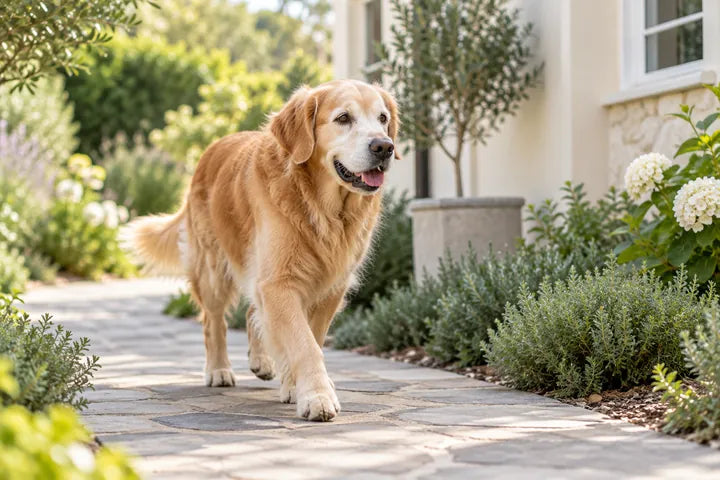
Dog weight joint health conversations often fail before they start, because they turn into a discussion about appearance. The useful framing is load: extra body fat is weight carried through every step, and it is the largest lever an owner controls.
This is general education rather than a diet plan. It explains how to assess body condition honestly, what to measure before starting, and how to keep the plan supervised rather than improvised. Body condition is one of the topics brought together in our guide to joint health for dogs and cats.

Dog weight joint health: assessing condition without a scale
You can assess body condition with your hands in about thirty seconds. Run your palms along the rib cage: you should feel each rib easily, without pressing, and without seeing them sharply.
Then look from above for a waist behind the ribs, and from the side for a tuck in front of the hind legs, because those two views describe the shape that carries load most efficiently.
Other checks are useful: fat pads over the hips and at the base of the tail, a rounded abdomen when viewed from the side, and the feel of the spine along the back. Owners often find the waist view the most revealing, because it is the angle they rarely look from. Body condition scoring systems convert these observations into a number, which makes tracking easier, and owner-facing condition resources explain the method (Association for Pet Obesity Prevention). Keep in mind that condition and muscle are different things: an older dog can lose muscle along the spine while gaining fat over the ribs, which is why both the hands and the scale belong in the picture. Reviews of obesity management in dogs and cats describe how the condition affects health and how weight reduction improves outcomes (canine and feline obesity management).
What should you measure before starting a weight plan?
Measure before you change anything. The movement side of a daily routine is discussed in exercise routines for arthritic dogs.
Record a starting weight on the same scale, a body condition score, the current daily food amount in grams rather than scoops, and the number of treats given in a typical day.
That last item is often the missing piece, because treats and table scraps can account for a large share of daily intake while feeling insignificant. Also record activity: how many minutes of walking per day, and whether that has changed recently, since reduced activity during a painful period can explain a gradual gain. Take photographs from the side and above so a month from now you have a visual comparison that does not depend on how the coat lies that day. Weigh and score together, because a dog can lose fat while gaining muscle, which is a good outcome that a scale alone would miss. If your dog has joint disease, tandem the plan with a veterinary assessment, as pain may need treatment before activity increases.
Rate of loss, portions and treats
The plan is arithmetic plus supervision, not a strict diet.
Work out the daily energy target with your veterinarian, measure food by weight, and count treats within that total rather than adding them on top.
Weigh food on a kitchen scale for the first few weeks, because scoop-based measurement varies widely between households and between people in the same household. Then keep the amount stable for two to three weeks before adjusting, since body weight fluctuates day to day and changing the plan weekly makes the response impossible to read. If treats are part of training, use part of the daily ration, break treats into smaller pieces, or use suitable vegetables. Avoid free-feeding in multi-pet homes, because you cannot measure intake when bowls are shared. If your dog begs, the usual cause is an inconsistent household rather than hunger, so agree on who feeds and how much. Any rapid weight loss, vomiting, or loss of appetite during a plan should prompt a clinic call rather than a stricter diet (feeding amounts and treat limits are covered in the site’s existing guides).
What to change at home this week
Start with measurement, then the environment.
Measure the food, weigh the dog, and log the treats, then remove the easiest sources of extra intake by keeping food off the floor and storing treats out of reach.
Protect activity at the same time, since the goal is fat loss rather than muscle loss: short, regular walks on level ground maintain muscle while the plan reduces intake. If your dog has joint pain, environmental changes make movement possible, including non-slip runners, a padded bed, and no repeated stair use. Keep the scale accessible and weigh your dog at the same time of day, ideally before breakfast, and record it with the date. Tell everyone in the household what the daily amount is, because an extra handful from a second person is invisible until you measure. A slower feeder or a food puzzle makes the smaller ration last longer, since feeding time shortens when the amount drops. Nutrient requirements are defined in relation to energy needs rather than volume, which is why measured amounts matter (Merck Veterinary Manual).
When does weight loss need supervision?
Supervision is the default rather than the exception.
Ask your veterinarian to set the target condition score and an expected rate of loss, and to review the plan at a defined weigh-in, because the appropriate rate depends on your dog’s age and other conditions.
Labelling and claim conventions vary by market, and the FEDIAF nutritional guidelines and AAFCO consumer material explain how pet food rules are framed. Call the clinic if your dog is losing weight quickly, if appetite changes, if there is vomiting or diarrhoea, or if your dog seems weak or unwilling to move. Older dogs deserve a check before beginning a plan, since unintended weight loss is a sign of illness rather than something to encourage. If your dog is on medication, mention it, because appetite and metabolism can be affected. Keep a comfort measure in the record as well, because the goal is improved mobility rather than a number, and a dog that is thinner but more painful has not benefited. Reviews of obesity management emphasise structured, monitored programmes rather than ad hoc restriction (canine and feline obesity management).
Reviewing progress at each weigh-in
Compare weight, body condition score, and mobility measures at the same intervals rather than judging by how your dog looks on a given day.
Good progress looks like a slow, steady change on the scale and improved willingness to move: your dog takes the stairs again, finishes the usual walk, or gets up more quickly.
If the scale has not moved after three weeks at the same intake, that is information rather than failure, and the plan needs a measured adjustment with veterinary input. If mobility has not improved despite weight loss, the next question is whether pain is being treated adequately, and that belongs in the same appointment. Keep the log, the photographs, and the condition score, because the trend across months is what matters for a joint that is loaded every day. Where supplements are part of the routine, judge them with a defined measure, and the site’s guide to choosing a joint supplement explains how.

If you want the wider framework for judging products, read the site’s pet supplement safety guide.
FAQ
How can I tell if my dog is overweight without a scale?
Use your hands and eyes. You should be able to feel the ribs without pressing hard, see a waist behind the rib cage from above, and notice a tuck in front of the hind legs from the side. A dog with no visible waist, ribs you cannot find, or fat pads over the hips is carrying extra condition. Scoring systems use a number, but the feel test is what most owners can apply consistently at home.
Does losing weight help a dog with joint problems?
Reducing excess body fat lowers the load carried through the joints at every step, and clinical guidance treats weight management as central to managing joint disease in dogs. Owners often see improved willingness to move before the scale change is dramatic. The plan should be gradual and supervised, because fast loss is not appropriate and can cause other problems, especially in older dogs.
How fast should a dog lose weight?
The rate depends on the starting body condition, the dog’s age, and any other conditions, which is why a veterinarian should set the target rather than a generic chart. A common principle is gradual loss with regular weigh-ins, using measured portions rather than a rough scoop, and adjusting only after two or three weeks at the same intake. Rapid loss in an older or unwell dog is a reason to stop and call the clinic.
Should treats be cut out completely during a weight plan?
No. Cutting treats entirely usually fails, because food rewards are part of daily life and training. Instead, account for treats within the daily calorie total, break a treat into smaller pieces, or use part of the daily food ration as a reward. Ask your veterinarian to help you build the plan so treats are included rather than treated as cheating, and measure everything for the first few weeks.