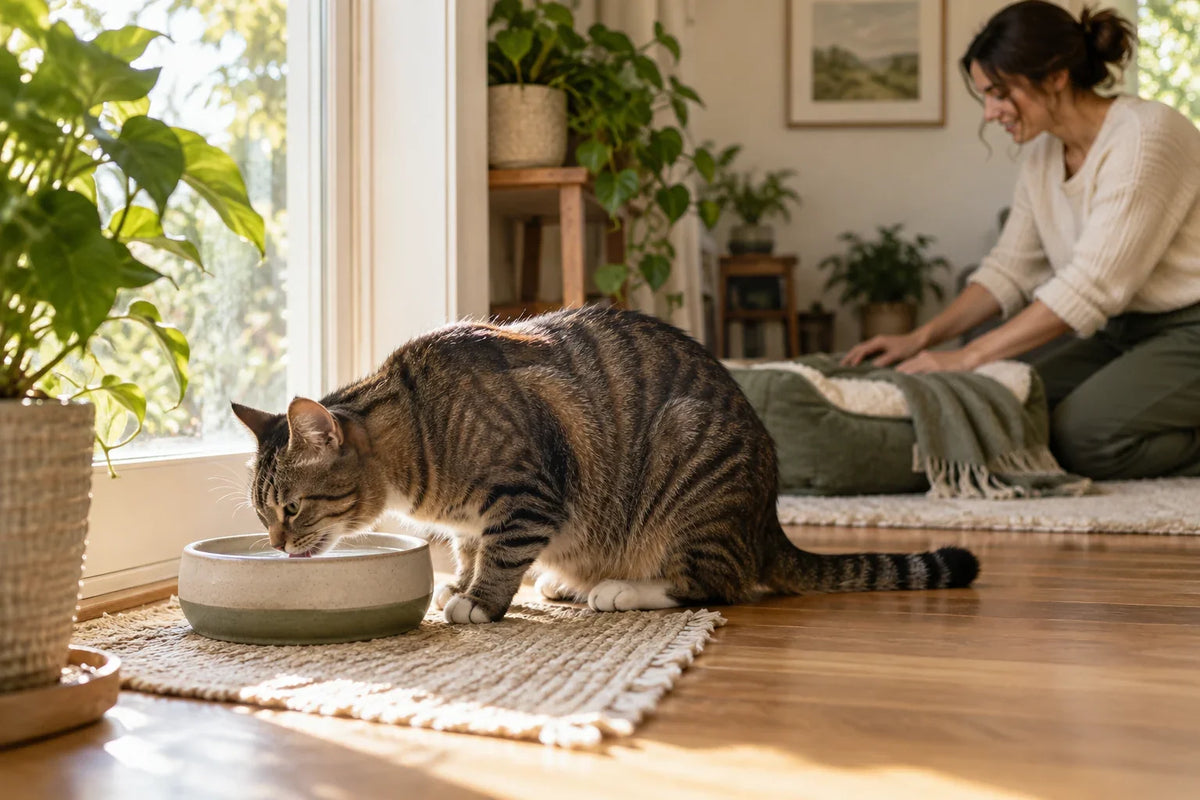
Indoor cat exercise is usually solved with a toy basket rather than a routine. Cats need short bursts of hunting-like activity and somewhere to climb, and both fit into a small flat once the space is used vertically.
This is general education rather than a behaviour programme. It explains which activities cats actually use, how to build a schedule, and what to measure so the plan is judged on results.

Indoor cat exercise: why a small space still works
Cats are built for short, intense bursts followed by rest, which is easier to accommodate in a small space than sustained exercise. Three five-minute sessions can achieve more than one long attempt.
Vertical space also changes the arithmetic of a flat. A cat tree, a shelf route, or a window perch adds usable territory without adding floor area, and height lets a cat move rather than simply sit.
The third element is problem-solving, which food puzzles and scatter feeding provide. Together, these three elements cover climbing, chasing, and thinking, which is what an indoor environment otherwise removes. Environmental needs for cats are described in feline practice guidance, and access to resources and space is a welfare issue rather than a luxury (AAFP practice guidelines). The Merck Veterinary Manual covers providing a home for a cat in more detail.
What do owners get wrong first?
Buying toys before setting up space is the first mistake.
A cat with nothing to climb will use a wand toy for a few minutes and then return to the same resting place, because nothing in the environment changed.
The second mistake is doing all the activity in one session, which most cats abandon partway through. The third is leaving every toy out permanently, because novelty drives play and a basket of familiar toys quickly stops producing a response. The fourth is interpreting night-time activity as a personality trait rather than as a sign that the cat’s active period happens when the household is asleep. Before buying anything, watch where your cat already spends time and add height or routes in those places rather than in an empty corner.
Which activities work in a flat?
A short list covers most indoor cats.
The table below pairs each activity with what it provides, and every item fits into a small flat once a shelf or a tree is in place.
| Activity | What it provides | Practical note |
|---|---|---|
| Wand toy sessions | Chasing and jumping | Short sessions, finish with a caught toy |
| Cat tree or shelf route | Climbing and territory | Place near a window if possible |
| Food puzzles and scatter feeding | Problem-solving and slower eating | Count the food within the daily ration |
| Rotated toys | Novelty | Keep some in a cupboard and swap weekly |
| Window perch with a view | Passive enrichment | Useful for older cats with limited mobility |
Older cats need gentler, shorter sessions, and stiffness often shows up as reduced jumping rather than limping, which is why the site’s article on subtle signs of stiffness in cats is relevant to any activity plan. Feeding format also matters if you are using food puzzles, and the site’s comparison of wet and dry food explains how format affects intake, which matters when part of the ration is used for puzzles.
What to change, in what order
Change the environment first, then the schedule.
First, add height and a route: a cat tree, a shelf, or a perch near a window, placed where your cat already rests.
Second, introduce two short play sessions at consistent times, ideally one before a meal, so the routine is predictable for the cat and easy for you to keep. Third, add one food puzzle using part of the daily ration rather than extra food. Fourth, rotate toys weekly so the supply stays novel. Keep the changes small and consistent, and give each one a week before adding the next, because several simultaneous changes make the effect impossible to judge. Handling routines such as nail care also affect activity levels, and the site’s guide to trimming a cat’s nails explains why long nails reduce grip during jumping and landing.
What should you measure, and when?
Measure behaviour that has a frequency, not mood.
Night-time activity episodes, vocalising, grooming duration, and how often your cat uses the high places are all countable over a week.
Record a baseline week before changing anything, then score the same measures during and after the change. A cat that settles sooner, sleeps more of the night, and uses the cat tree is showing the response you were aiming for. If instead the cat becomes more demanding, the sessions may be too short or too predictable, or the cat may need more problem-solving rather than more chasing. Stress also influences behaviour in cats, and research describes measurable responses to environmental stressors (stressors in domestic cats).
When does inactivity need veterinary assessment?
Book if activity changes with other signs.
Weight loss, appetite change, vomiting, litter box changes, or sudden withdrawal all point towards a medical cause rather than an enrichment gap.
Also book if your cat is reluctant to jump, is stiff after rest, or has stopped using the high places you have provided, because those changes often reflect joint pain rather than preference. Owner-level guidance on feline behaviour and welfare is available from International Cat Care, and problem behaviours in cats are covered in the Merck Veterinary Manual. If the assessment finds no medical cause, a behaviour plan can target the specific behaviour rather than the general idea of exercise.
What to record and review
Keep a two-week page and compare.
Record play sessions, puzzle use, night-time episodes, grooming, and appetite, then review the whole page at two weeks rather than relying on the sense that the cat seems happier.
If the plan worked, keep the routine and the toys that produced a response, because novelty and predictability both matter and are easy to lose when a schedule slips.

Older cats and cats with joint pain often need shorter, gentler sessions, so the plan should change with the cat rather than staying fixed.
If it did not work, the limiting factor may be pain, so the next step is an examination rather than more equipment. Recording also makes it easier to explain the situation at an appointment, since behaviour changes are difficult to describe from memory alone.
If you want the wider view of feline care, the site’s FAQ answers the questions owners ask most often.
FAQ
How do I exercise an indoor cat in a small flat?
Use vertical space and short, frequent sessions rather than one long play period. A cat tree, shelves, a window perch, and a couple of wand toys cover most of what cats need, and two or three five-minute sessions a day usually achieve more than one longer attempt. Rotating toys keeps interest, and food puzzles add activity without requiring more space.
How much play does an indoor cat need each day?
Most indoor cats do well with several short play sessions daily, with the total depending on age and temperament. Kittens and young adults want more, and older cats often do better with shorter, gentler sessions. The reliable test is behaviour: a cat with enough activity tends to settle, while one without it often vocalises, overgrooms, or becomes active at night.
Can food puzzles replace play?
They complement play rather than replacing it entirely. Puzzles provide problem-solving and slow eating, which is useful for cats that eat quickly and for weight management, while play provides the chasing and jumping that maintain muscle and coordination. Using both approaches, and measuring behaviour over a couple of weeks, usually produces better results than choosing one and hoping it covers everything.
What are the signs an indoor cat is under-stimulated?
Common signs include night-time activity, vocalising, overgrooming, attention-seeking, and changes in appetite or litter box habits. Some cats become withdrawn rather than demanding. Those signs overlap with medical problems, so a persistent change deserves an assessment rather than more toys. If the change is recent and behaviour only, increasing activity and structure is a reasonable first step.