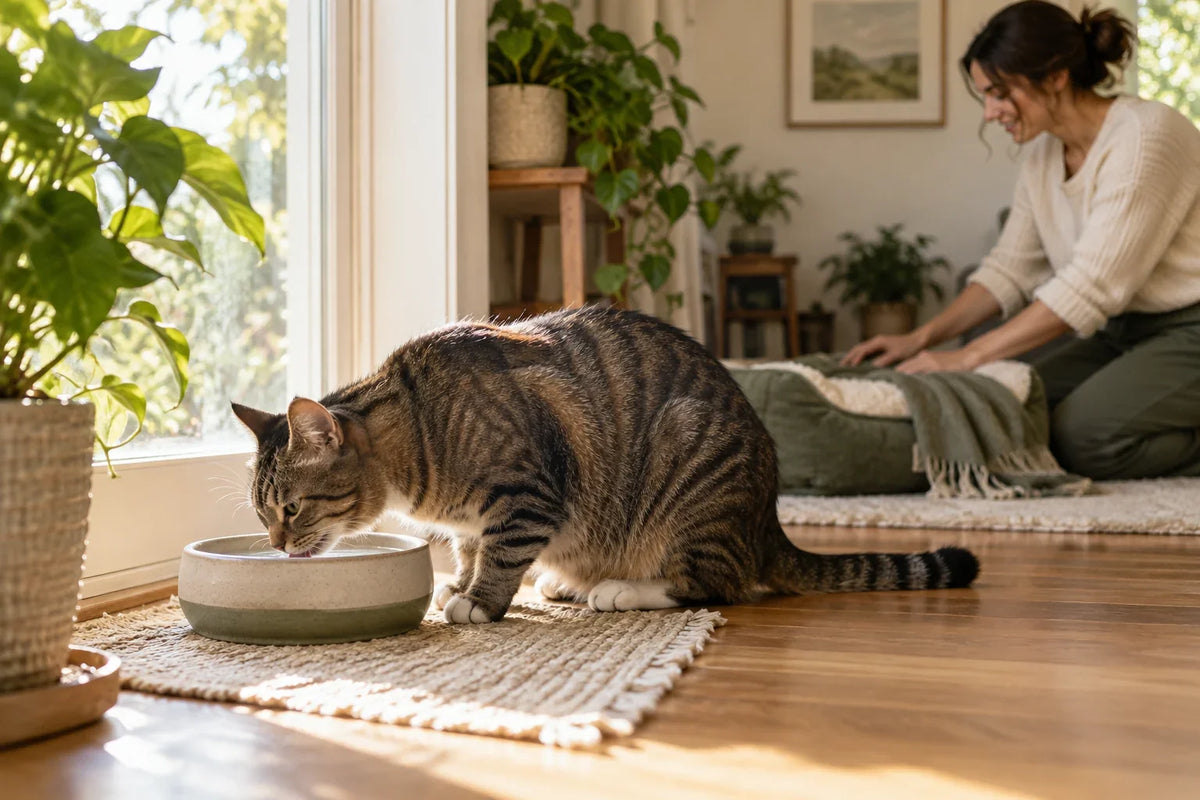
Cat not drinking water is one of the most common worries owners raise, and often the answer is that the cat is taking in plenty of moisture from food. The useful question is whether total intake is adequate, not how much goes into the bowl.
This is general education rather than a diagnosis. It explains how to estimate intake, which changes reliably increase it, and when a change in drinking or output needs a veterinary assessment.

Cat not drinking water: what normal intake looks like
Cats evolved as predators of prey with high water content, and their thirst drive is comparatively low. Many cats drink little from a bowl and stay well hydrated because wet food supplies most of their water.
That makes bowl volume a poor measure on its own. A cat eating wet food twice a day may take in most of its fluid with meals, while a cat on dry food typically drinks considerably more.
Practical estimation means combining both sources: measure water in and water left over three days, then account roughly for the moisture in the food. Litter box output is the second half of the picture, since urine clumps or litter weight show what is coming out. Evidence on diet format and water intake in cats shows how strongly food composition influences total water turnover (diet and water intake in cats), and the Merck Veterinary Manual describes how kidney and urinary changes are detected in cats.
What do owners get wrong first?
Judging hydration by the bowl is the first mistake.
Bowl size, spillage, and food moisture all distort the impression, and a cat on wet food may drink almost nothing from the bowl without any problem.
The second mistake is adding water to a cat’s food so generously that the meal becomes unappetising, which reduces intake rather than increasing it. The third is offering a fountain or a new bowl and expecting an immediate change, when many cats need several days to investigate something unfamiliar. The fourth is misreading dehydration signs, since tacky gums, skin that stays tented, and a flat demeanour are more reliable than the amount of water in the bowl. Owner-level guidance on feline care and hydration is available from International Cat Care.
Which fixes increase water intake?
Some changes work for most cats.
Others suit only some cats, and the table below pairs each change with the reason it works and the practical limit.
| Change | Why it works | Practical limit |
|---|---|---|
| Wet or mixed feeding | Water arrives with the food | Requires a gradual diet transition |
| Adding warm water to meals | Increases moisture without changing diet | Too much spoils acceptance |
| Several water stations | Reduces effort and competition | All need regular cleaning |
| Wide, shallow bowls | Avoids whisker contact | Small improvement, easy to test |
| A fountain | Some cats prefer moving water | Needs frequent cleaning |
Water stations work best when they are away from food and litter boxes, because cats are sensitive about contamination near resources. Diet format remains the largest lever, and research on feline urinary health describes how diet composition affects urinary risk (diet and feline urinary tract health). The site’s comparison of wet and dry food for cats explains the trade-offs in more detail, and the site’s article on subtle signs in cats explains why quiet changes in drinking and appetite deserve attention.
What to change, in what order
Start with the change that requires no new equipment.
First, add a tablespoon of warm water to each meal and see whether your cat accepts it, because that single step increases moisture without altering the diet.
Second, add a second water station in a quiet place away from food and litter, and use a wide bowl. Third, if your cat is interested in taps or running water, try a fountain and clean it weekly. Fourth, if intake is still low and the diet is dry, discuss a gradual transition to a mixed or wet diet with your veterinarian. Change one thing at a time and give each change several days, because cats investigate novelty slowly and the effect of two simultaneous changes is unreadable.
What should you measure, and when?
Measure intake and output together over three days.
Record water offered and left, the number of urine clumps or the weight of soiled litter, stool, appetite, and the diet, then repeat the measurement after each change.
The comparison between the two periods tells you whether the change worked far better than an impression, because hydration is difficult to judge by eye. Weigh your cat monthly as well, since weight change often accompanies a change in intake. If your cat is on a prescription diet, keep the format as instructed rather than adding water unless the clinic advises it, because therapeutic diets are formulated to deliver specific amounts. Where the concern relates to a diagnosed condition, measurements should follow the clinic’s monitoring plan rather than a home schedule.
When does hydration need veterinary assessment?
Book if intake changes and persists.
Book promptly if there is appetite loss, weight loss, vomiting, reduced grooming, or a cat that seems flat, because those combinations point towards a medical cause rather than a feeding issue.
Contact a clinic urgently if a cat cannot keep water down, is straining to urinate with little or no urine produced, or seems weak, since urinary blockage becomes life-threatening within hours. Bring your measurements and the food details, and ask whether blood work or a urine sample is warranted. The Merck Veterinary Manual describes the feline urinary system, and the site’s FAQ answers common questions about everyday cat care.
What to record and review
Keep one page for the measurement period.
Record the diet, water offered and left, urine output, appetite, and weight, then compare the same measures after each change rather than judging from a single day.
A record that shows intake stable and output normal is reassuring, and a record that shows a sustained change is the most useful thing you can bring to an appointment. Keep the earlier pages, because the trend across months is what makes a change meaningful rather than incidental.

If a diet change is part of the plan, transition it gradually rather than switching overnight, and note the date so the measurement periods stay comparable.
If you want the wider view of feline care, the site’s FAQ answers the questions owners ask most often.
FAQ
How much water should a cat drink a day?
Cats generally need less water from the bowl than dogs of comparable size, and much of their intake comes from food. A useful approach is to measure intake over three days and compare it with your own cat’s baseline, then add what the diet contributes. A cat eating wet food may drink very little and still be well hydrated, while a cat on dry food usually drinks noticeably more.
How can I get my cat to drink more water?
Offer wet food, add a little warm water to meals, provide several water stations away from food and litter boxes, use wide bowls that do not press on the whiskers, and keep the water fresh. Some cats prefer running water and drink more from a fountain. Change one thing at a time and measure the effect, because acceptance varies between cats.
Is a water fountain better than a bowl?
Some cats drink more from moving water, and others ignore it. A fountain is worth trying if your cat shows interest in taps or running water, and it needs regular cleaning because biofilm forms in the pump and reservoir. If your cat shows no interest after a week, a still bowl in a better location may be the more effective change.
When is a cat not drinking enough a medical problem?
A cat that stops drinking, or whose water intake drops alongside appetite loss, weight loss, vomiting, or reduced grooming, needs an assessment. Signs of dehydration include tacky gums, skin that stays tented, and a cat that seems flat. Do not syringe water into a cat’s mouth, because it risks choking and gives a false sense of how much fluid was taken in.