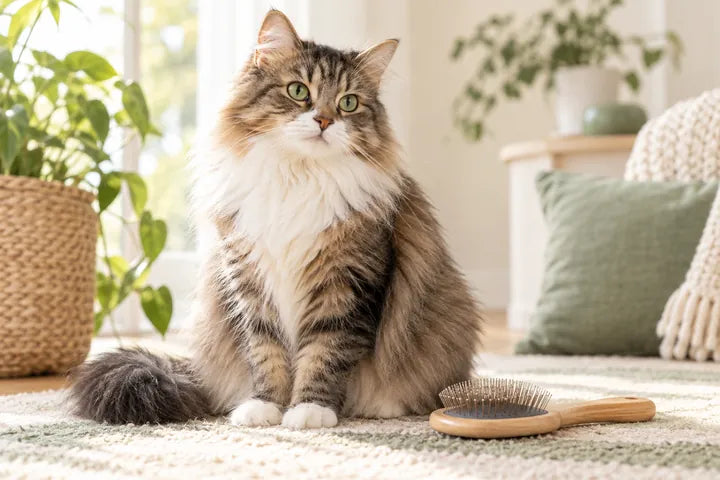
Hairballs cats bring up are one of the few symptoms owners accept as normal, and the reason is that they sometimes are. The question is frequency, because a rare event and a weekly habit mean very different things, and hairballs are only part of the picture if your cat is also overgrooming.
This is general education rather than a treatment plan. It explains how to count episodes, what each pathway looks like, and why vomiting hair is often a coat problem rather than a stomach problem.

Hairballs cats bring up: how often is too often
Occasional hair accumulation, especially in long-haired cats and during shedding, is common. More than about once a month, or any pattern that is increasing, is worth investigating.
The useful measure is episodes per month, together with what else comes up, because vomiting food or fluid alongside hair points away from simple hair accumulation.
Vomiting in cats is never entirely benign, since it can reflect a wide range of conditions, and the Merck Veterinary Manual treats it as a sign with many causes rather than a diagnosis. Cats that bring up hair frequently are often overgrooming, which means the underlying driver may be itch, pain, or stress rather than the hair itself. Counting the episodes for a month, and noting their timing relative to meals and grooming, gives you a pattern that is far more useful at an appointment than the impression that your cat vomits hair sometimes.
What do owners get wrong first?
Treating hair before grooming is the first mistake.
A cat that swallows more hair than usual is usually grooming more than usual, and that change has its own causes, including skin irritation, parasites, allergy, or discomfort somewhere on the body.
The second mistake is assuming that a hairball product cannot do harm, when lubricants and fibre supplements change stool consistency and can cause problems in cats with other conditions. The third is changing the diet and adding a paste at the same time, which makes the result uninterpretable. The fourth is accepting frequent vomiting as normal in a cat, which is how significant weight loss and dental disease go unnoticed. Before changing anything, check the coat and skin, count the episodes, and record your cat’s weight if you can weigh them, since weight is the clearest signal that something has changed.
Which pathway fits your cat?
Three pathways cover most hairball complaints.
The table below pairs each pattern with the first step worth taking, and coat condition is the detail that changes the plan most.
| Pattern | Likely pathway | First step |
|---|---|---|
| Rare episodes, long-haired cat, shedding season | Normal grooming output | Regular brushing and monitoring |
| Frequent episodes with bald patches or scabs | Overgrooming from itch or pain | Veterinary examination |
| Vomiting food or fluid as well as hair | Digestive or other condition | Veterinary assessment |
| Episodes after fast eating or big meals | Eating pattern | Smaller, more frequent meals |
Fibre and diet format sit in the middle of this discussion. Studies in cats have examined fibre sources and their effects on stool quality and hairball formation, which suggests diet can influence how hair moves through the gut in some cats (fibre and hairball formation in cats, dietary fibre sources and hairball measures). What diet cannot do is resolve overgrooming driven by itch or pain, and the gut conditions that produce vomiting are covered separately in the manual’s material on disorders of the stomach and intestines in cats.
What to change, in what order
Start with grooming and measurement, not with products.
First, count episodes for a month and note what comes up, then brush your cat regularly if they accept it, since removing loose hair reduces what is swallowed.
Second, check the coat and skin for bald patches, scabs, fleas, or irritation, because those findings change the plan entirely. Third, review the feeding routine, since rapid eating and large meals produce vomiting in some cats, and smaller, more frequent meals are a simple test. Fourth, if the pattern persists and the coat is normal, discuss diet with your veterinarian rather than adding a lubricant on your own. Where medication becomes necessary, the site’s guides to pilling a cat and to giving liquid medicine make the routine manageable.
What should you see, and when?
Brushing and meal timing take a few weeks.
If diet is changed as part of the plan, allow several weeks and make the transition gradually, because a sudden change produces digestive upset that is easy to misread.
Record episodes, what comes up, appetite, and weight, and photograph any coat changes so the comparison is objective. If episodes reduce but the coat condition worsens, the grooming problem is unresolved, and that is a reason to seek advice rather than to continue the same plan. If nothing changes, the next step is an examination rather than another product. Where hairballs form part of a broader pattern of quiet changes in a cat, the site’s article on subtle signs in cats explains why those deserve attention as well.
When is it more than a hairball?
Book an appointment if vomiting is frequent.
Also book if you see food or fluid coming up, if your cat seems uncomfortable when handled, or if the pattern has been treated with a hairball product without improvement.
Ask what the vomiting pattern suggests, whether the coat and skin are contributing, and whether weight loss has occurred since the last visit. Ask how long a dietary approach should be given before deciding, and what to change first. If your cat is overgrooming, the assessment overlaps with skin and behaviour questions, and the Merck Veterinary Manual describes the causes of hair loss in cats. Owner-level feline advice is also available from International Cat Care.
What to record and review
Keep one page for a month and review it before deciding anything.
Record each episode with the date, what came up, and how your cat behaved afterwards, then add weekly weight if you can weigh consistently, plus any changes to diet, grooming, or environment.
The pattern is what shows whether this is normal grooming output or something that needs investigation, and it prevents the common cycle of trying products without evidence. If the episodes reduce, note what changed at the same time, since that tells you which measure to keep. If they increase, book an appointment and bring the page, because frequency and content are the details that guide the next step. The site’s FAQ answers common questions about feline care and feeding.

If you want the wider view of feline care, the site’s FAQ answers the questions owners ask most often.
FAQ
How often do cats normally get hairballs?
Occasional hairballs, particularly in long-haired cats during shedding seasons, are common and usually harmless. Vomiting hair frequently, or vomiting hair alongside food or fluid several times a week, is not routine and deserves assessment. Frequency is the useful measure, so counting episodes over a month gives a veterinarian something concrete to interpret rather than a general impression of a cat who brings up hair.
Do hairball remedies actually work?
Some lubricant products and high-fibre diets appear to help in individual cats, and the evidence is limited and product specific. What matters more is why the cat is vomiting: overgrooming, skin disease, rapid eating, or a digestive condition all produce similar signs. A product that masks the sign without addressing the cause delays diagnosis, which is why the first step is scoring frequency rather than buying a paste.
Can diet reduce hairballs in cats?
Fibre source and diet format can change how hair moves through the gut. Studies in cats have examined fibre sources and their effects on stool quality and hairball formation, and results suggest some fibres help in some cats. Diet changes should be made gradually and one at a time, with the rest of the routine stable, so the effect can be judged. Ask your veterinarian which approach suits your cat’s health.
When is a hairball a sign of a problem?
It is a sign to investigate when vomiting becomes frequent, when your cat loses weight, goes off food, seems quieter than usual, or vomits fluid or food as well as hair. Cats that overgroom because of itching or pain often swallow more hair, so the coat and skin need checking. Frequent vomiting in a cat is never something to accept as normal, even when hair is present.