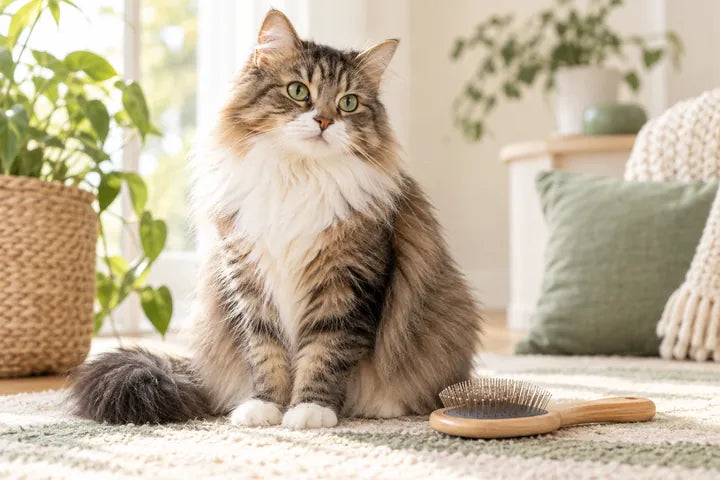
Grooming cat hates it problems are usually solved by making each session shorter rather than by finding a better brush. Cats accept handling when it is predictable, brief, and rewarded, and they refuse it when it is sudden or forceful.
This is general education rather than a behaviour programme. It explains what makes handling difficult, which steps build tolerance, and when professional grooming or veterinary care is the better option. Cat grooming belongs alongside other questions about skin and coat care; the topic brings those articles together.

Grooming cat hates it: what makes handling difficult
Cats are not naturally handled animals, and their tolerance depends on early experience. A cat that was rarely handled as a kitten often finds restraint unfamiliar rather than painful.
Discomfort is the second factor. Sore hips, dental pain, or a tender area under a mat make handling genuinely unpleasant, and the cat’s response is reasonable rather than dramatic.
The third factor is how sessions end. A cat that is held until the job is finished learns that restraint continues until it struggles harder, which teaches the opposite of tolerance. Routine health care for cats includes handling for grooming and checks, and the Merck Veterinary Manual covers the wider schedule. Handling stress in cats is measurable, and research on domestic cats describes how significant those responses can be (stressors in domestic cats).
What do owners get wrong first?
Attempting the whole job in one session is the first mistake.
A ten-minute grooming session that ends in a struggle sets the routine back, while three one-minute sessions across a week build tolerance without drama.
The second mistake is scruffing, which does not reliably calm adult cats, can cause discomfort, and increases fear of handling over time. The third is cutting mats out with scissors, which is a common cause of skin injuries. The fourth is giving up entirely, because a cat that is never groomed develops mats that pull on the skin and make handling even less tolerable. Start with the areas your cat tolerates best and accept partial progress.
Which steps build tolerance?
Work from the least intrusive contact to the most. For a coat-specific starting point, read grooming for different coat types.
Begin with a hand resting briefly on the shoulder while your cat eats, then a single brush stroke on one side, then a few strokes, and only then attempt the areas your cat finds hardest.
| Step | What to do | Stop when |
|---|---|---|
| Contact | Hand on shoulder for two seconds | Tail flicks or ears rotate |
| Single stroke | One brush stroke on the flank | Skin ripples or cat turns |
| Repeat strokes | Three or four strokes, same side | Any attempt to leave |
| Harder areas | Hindquarters, belly, under the chin | Immediately if the cat objects |
| Tools | Try a soft mitt if a brush is refused | If the alternative is also refused |
Rewards should be given after each step rather than only at the end, so the association is with the handling rather than with being released, which is what makes a cat learn to tolerate more over time. The same principle applies to other routines, and the site’s guides to trimming nails and to giving a pill follow the same staged approach. Owner-level handling guidance is also available from International Cat Care and the AAFP practice guidelines.
What to change, in what order
Change the session length first, then the tool.
Cut every session down to under a minute and end while your cat is still comfortable, then repeat daily rather than weekly.
Second, choose a time when your cat is relaxed and slightly hungry, and pair the session with food so the routine is something the cat anticipates rather than endures. Third, if a brush is refused, try a soft rubber mitt or a grooming glove, since many cats accept one tool and refuse another even when the handling itself is identical. Fourth, if the coat is matted, ask a professional for help rather than working at it for longer at home. Cats with joint pain often find grooming uncomfortable, and the site’s article on subtle signs of stiffness in cats explains why that possibility should be considered before the behaviour is labelled difficult.
What should you measure, and when?
Measure tolerance in seconds and strokes.
Record how long your cat tolerated handling and how many strokes were achieved, then compare over a fortnight rather than judging from one session, because individual sessions vary with mood and with what happened earlier in the day.
Progress of a few seconds a week is a good outcome, and it often accelerates once the cat learns that sessions end before they become unpleasant. Note which areas remain difficult, because those are the ones likely to need professional help rather than more practice at home. If tolerance decreases, look for a source of discomfort, since pain rather than temperament is a common explanation for a sudden change in behaviour. The Merck Veterinary Manual covers hair loss in cats, and coat changes are worth recording alongside handling notes.
When should grooming be done by a professional?
Book help for tight mats.
Also book if handling has caused a scratch or a bite, if your cat becomes distressed every time, or if the coat condition is worsening despite regular sessions.
Ask what the appointment will involve, since some cats are groomed with gentle handling and others need sedation, which is a veterinary decision. Long-haired cats often need professional help periodically even when home routines work, and accepting that is more useful than trying to solve everything at home. Where a medical reason makes the coat unmanageable, treating the underlying problem improves handling more than any tool.
What to record and review
Keep a short log of sessions.
Record the date, the duration tolerated, the areas completed, and the tool used, along with any coat changes and any professional appointment, then review the trend monthly.
The log shows whether the plan is working, which is difficult to judge from individual sessions, and it makes the decision about professional help objective rather than a matter of frustration. Where an area remains impossible, focus on keeping it free of mats rather than on achieving a full groom.

Short sessions that end well are the mechanism behind progress, so protecting those good endings matters more than completing the coat in any single week.
If you want the wider view of feline care and handling, the site’s FAQ answers the questions owners ask most often.
FAQ
How do I groom a cat that hates being touched?
Work in very short sessions and build the routine in stages: first touching the shoulder while your cat eats, then a brush stroke on one side, then a few more. Stop before your cat objects, and reward every step. Progress takes weeks rather than days, and a partial routine applied consistently usually achieves more than a full grooming session attempted once.
Should I scruff my cat to groom it?
Scruffing is not recommended as a handling method. It does not reliably calm adult cats, it can cause discomfort, and it tends to increase fear of handling over time rather than reducing it. For procedures that genuinely require restraint, ask your veterinarian or a professional groomer for a technique that suits your cat, and practise that approach in short sessions so the cat learns what to expect.
What if my cat will not tolerate brushing at all?
Try a different tool first, because many cats accept a soft rubber mitt or a grooming glove where they refuse a brush. If handling remains unacceptable, focus on the areas that matter most, such as the hindquarters where matting forms, and ask a professional groomer to do the rest. Keeping mats under control prevents skin problems that make handling even harder later.
How do I groom a cat with matted fur?
Do not cut mats out with scissors, because the skin is easily injured. Small mats can sometimes be worked out gently with a comb, but tight mats close to the skin usually need professional attention, and some need clipping under sedation. Book an appointment if the coat is painful to touch or if the skin underneath looks red or damaged.